Four sizes · 13–57 seats
What Size Charter Bus Does Your Group Need?
It is seven in the morning, forty-six people are on the sidewalk with their bags, and the vehicle at the curb seats forty-four. Two of them are about to be told they are riding separately, and the day starts with someone deciding which two. Getting that settled long before the day is what this guide is for, along with the opposite mistake — rounding up to a size the day never called for.
Start with a number you can stand behind. Not the invite list and not the RSVP count — the number of people who will actually be standing at the curb, including chaperones, coaches, coordinators, and anyone riding one direction only. That is the number a vehicle gets matched to, and it is the number we quote against.
What decides which vehicle fits
- Everyone who takes a seat — passengers, chaperones and staff, plus anyone joining for the return leg only
- Anyone driving themselves and meeting you there, so they are not counted twice
- Suitcases, equipment bags, instrument cases and boxes
- How long the longest single leg runs, door to door
- Whether the number is firm or still moving
The four sizes we run
Every capacity below is printed as a range rather than a single figure, because seat count varies by configuration; if your number sits near a ceiling, we confirm the exact seat count on the vehicle we assign when we quote rather than quietly promising you the top of a range. Read across to the top figure of each range first — that is the number that tells you whether your group fits at all. A group smaller than the bottom of the smallest range is not too small to ask, and it travels in the Executive Sprinter Van.
| Vehicle | Passengers | Best for |
|---|---|---|
| Supercoach Bus | 50–57 | Large school groups, Sporting events, Large weddings, Major group outings |
| Coach Bus | 39–44 | Larger corporate groups, School trips, Sports groups, Wedding transportation |
| Small Coach Bus | 22–28 | Smaller school groups, Wedding parties, Corporate outings, Medium-sized private groups |
| Executive Sprinter Van | 13–16 | Executive groups, Airport transportation, Small wedding parties, Small private groups |
Every vehicle we run. The bar under each range is drawn against the largest, so the four sizes read as one scale rather than four numbers.
50–57 passengers
Large school groups, Sporting events, Large weddings, Major group outings
39–44 passengers
Larger corporate groups, School trips, Sports groups, Wedding transportation
22–28 passengers
Smaller school groups, Wedding parties, Corporate outings, Medium-sized private groups
13–16 passengers
Executive groups, Airport transportation, Small wedding parties, Small private groups
The usual answer is the smallest vehicle whose top figure covers your group — there is no sense moving empty seats across the city. The rest of this guide is the set of cases where that answer is wrong. Photographs of all four are on the fleet page.
Executive Sprinter Van
The van is the answer when the group was never large enough for splitting it to be the question. It also parks where a coach cannot — a hotel entrance, an office driveway, an airport curb — so the day loses the walk between the vehicle and the door, which on a short hop is most of what people notice. Its tight edge is bags rather than seats: a full load heading to a terminal with checked luggage is a different problem from the same load heading to dinner, so tell us which one you are. Corporate work that never needs a full coach starts here.
Small Coach Bus
This is the size that answers the headcount with no other good answer: too many for the van, a long way short of filling the largest size. Two vans would seat the same people and buy you nothing but a second set of arrival times. The wedding version — ceremony, photos, reception, all on one vehicle — is where it earns its place, because the group that has to move together is usually far smaller than the guest list. It is also the size where a late swing of five people changes the answer, so give us a range if the count is still live.
Coach Bus
Most groups arrive at this size by elimination: past what the Small Coach Bus seats, not near enough the largest size to justify it. That makes an unsettled headcount matter more here than anywhere else, because nothing sits between this size and the Supercoach Bus — a count that drifts over the top of its range does not move you into a slightly larger vehicle, it moves the whole group up a size. A school trip is the usual version of that, since rosters gain people in the last week and rarely lose them.
Supercoach Bus
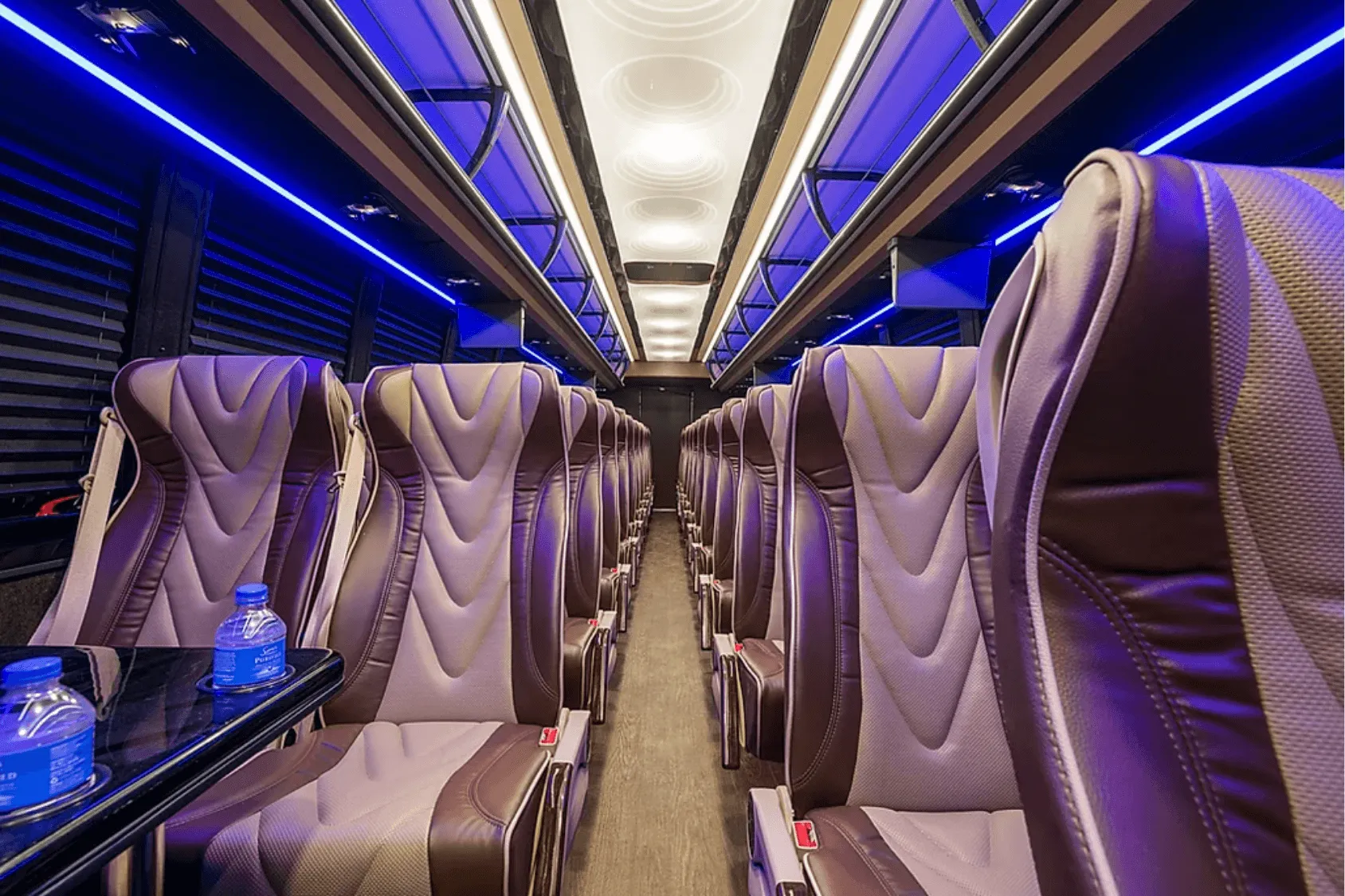
The largest size we run, and the one to ask about when the alternative is splitting the group. Two parts of its specification bear on sizing rather than on comfort alone: high back leather reclining seats and a USB charging port at every seat are what let a full load hold up over a long day instead of merely fitting into one. Stadium days are where the size is least negotiable — sporting events put your whole group through one set of gates inside one window, and two arrivals mean two walks in. Above what a Coach Bus seats, this is the size we quote.
What a headcount does not tell you
Luggage
Forty passengers with day bags and forty with rolling suitcases are not the same booking. The Supercoach Bus is the only size whose luggage arrangement we publish — overhead space, with undercarriage luggage available on request. For the other three we have not published a specification, so ask us what one of them actually holds before you plan around it. We would rather answer the question than print a guess.
Equipment and gear
Gear riding in the cabin takes seats. A team with equipment bags, a band with instrument cases, a trade show crew with pop-up displays and boxes of collateral can all clear the headcount and still be short of room. Count the gear as if it were passengers, or tell us what it is and we will tell you where it goes. It is one of the things that makes youth group and team travel different from an adult outing of the same size.
Fitting and being comfortable are different questions
A vehicle at its stated capacity is full. That is a non-event on a short hop to the Museum Campus and a long stretch on a run out to the suburbs, where people want a bag beside them, a coat somewhere, and no elbow negotiation. If your group sits a handful under a ceiling, moving up a size gives the whole group room rather than giving anyone a luxury. What that trade does to a quote is a separate subject, and what goes into a charter price covers it.
Longer trips change the calculation
On a short hop across the Loop, a bus at its limit barely registers. Everyone is seated for the length of one song and out. On a run up Lake Shore Drive, or a day out and back through the suburbs with several stops in it, the same bus is a different experience: bags come out of the racks, coats end up on seats, people spread out, and somebody sleeps.
So the rule of thumb inverts with time in the seat. Short urban runs can size tight. Anything over an hour in the seat, or a day where the group stays with the vehicle between stops, should size with room to spare — round up rather than down, especially when the day has several legs.
One vehicle, one headcount, one arrival
Two smaller vehicles will seat the same people as one larger one, and it is not the same trip. Two means two counts at every stop, two arrival times, and two drivers working one timeline from different points in traffic.
It shows up hardest at stadiums, where two coaches do not necessarily end up parked in the same place, and the group that got there first waits for the group that did not. If one bus seats everyone, take it.
When the number is still moving
Plenty of groups book before the count is final. Weddings do it, conferences do it, and school trips do it every year. Book to the number you honestly expect rather than the number you are hoping for, and say out loud that it is a range — a group that might land anywhere between 38 and 46 is a different conversation from a firm 40.
Say it early, as well. Tell us the range when you first ask rather than after a size has been matched to the trip: we quote against the number you give us, and a group that grows past that size's ceiling becomes a different vehicle and a new quote. How much runway you have before the count has to firm up is its own question, and how far ahead to ask works through it.