No flat rate · Quoted per trip
How Much Does a Charter Bus Cost in Chicago?
Every charter is quoted against one specific day, and the day does the deciding — who is traveling, how long the vehicle stays with them, where it goes, and what the roads are doing while it gets there. What moves the number is a short list, and it is longer than most people expect. Below is what each input does, and what to send us so the figure that comes back reflects the trip as you described it.

Why there is no flat rate
A charter is not a product on a shelf. Every trip commits a specific vehicle and a specific driver for a specific number of hours over a specific distance, and those four things are different every single time.
That variation works in your favor. A single published rate would have to cover the hardest version of the trip, the longest day with the worst traffic window and the most stops, and everyone would pay it. Working from the facts of your day instead means a Tuesday morning staff shuttle is not subsidizing a Saturday night wedding return.
| What changes | What it changes |
|---|---|
| Passenger count | Which of the four sizes seats the group: Executive Sprinter Van, Small Coach Bus, Coach Bus or Supercoach Bus |
| Trip distance | How many miles the day covers |
| Hours held | How long a vehicle and driver stay with your group, waiting included |
| Pickup and destination | Where the vehicle has to be, and what it takes to get it there |
| Additional stops | Route length and time on the clock |
| Date and day of week | How many vehicles are free, and how early to ask |
| Time of day | Whether the run crosses a rush window |
| Parking and route | Where a motorcoach can legally wait, and which roads the day uses |
Start with the group
How many people are actually going
Headcount is the first thing we ask, because it decides the vehicle, and the vehicle sits underneath everything else. Count everyone who boards: chaperones, coaches, the photographer, the two people who swore they would drive themselves. A count that grows by six after the quote goes out can change which vehicle we send.
If the number is still moving, give us your best estimate and say that it is one. We would rather work from an honest estimate than requote three times off a number that was never firm.
Which vehicle that puts you on
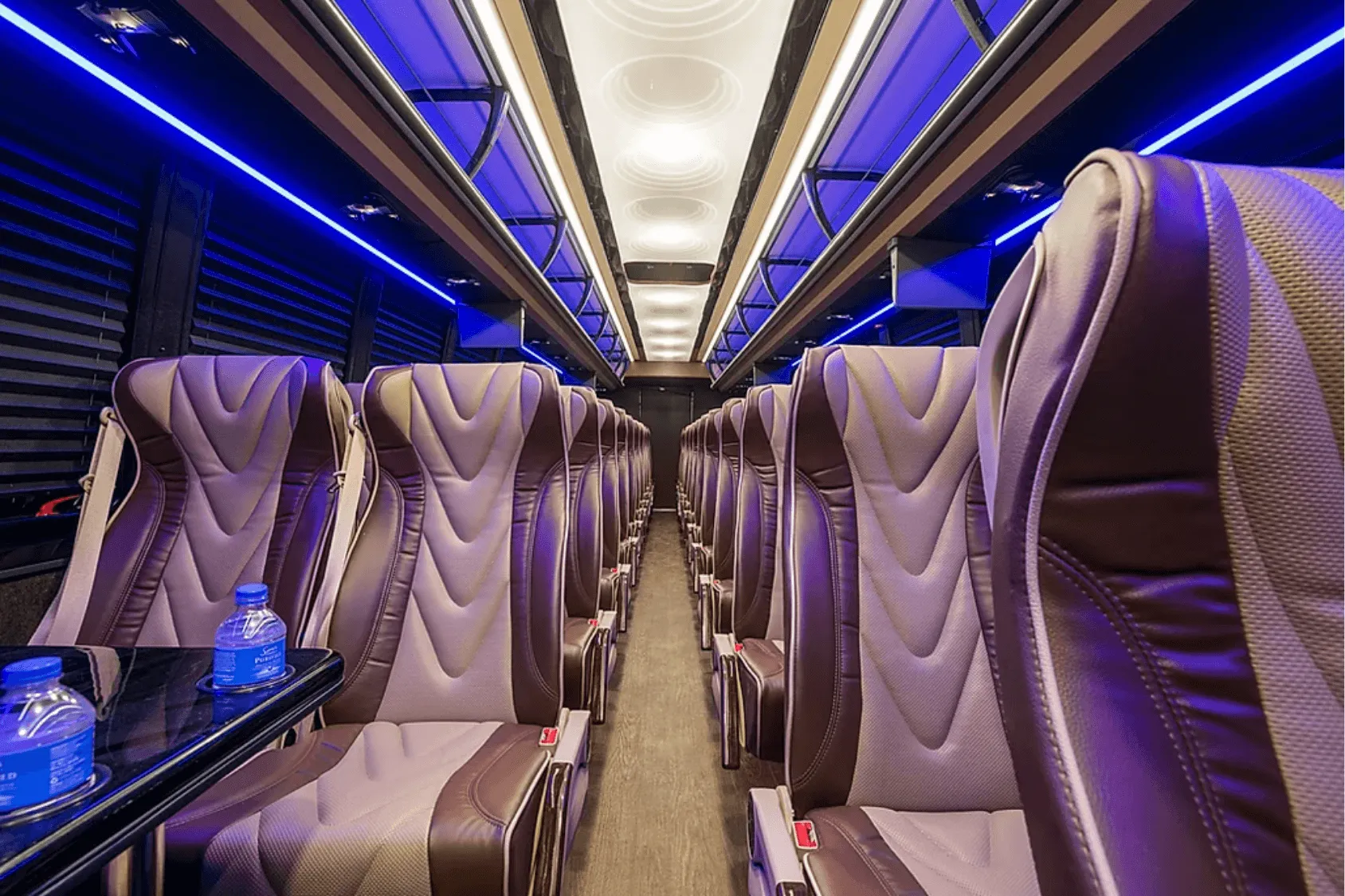
Four sizes, four capacity ranges. Ask about the smallest one that seats your group comfortably, and if you are close to the edge of a size, say so. You can see the full fleet, with capacities and photographs, before you ask us anything.
Groups landing near the top of a capacity are worth talking through. If you are between two sizes, or above 57 passengers and wondering whether that means a second vehicle, our guide to choosing a size works through the awkward middle cases.
Distance and hours
How far the vehicle travels
Mileage is the straightforward part. A run from the Loop to Navy Pier is not a run from a west suburban school out to a north suburban venue and back, and the difference shows up in fuel and in driver time.
What people forget is the empty mileage. The vehicle still has to reach your pickup and get home after your last drop, with nobody aboard for either leg, so where the day starts and ends shapes the schedule as much as the distance between the two.
How long it is committed
A charter holds a vehicle and a driver for a stretch of the day, and the stretch includes the hours nothing moves. Picked up at eight, dropped back at six: the driver is with your group all day even if the coach sits still between ten and four. Tell us the hours you need the vehicle held, waiting included.
This is why an all-day corporate shuttle and a one-way transfer over the same distance are not the same trip at all. Tell us the shape of the day, one run out and one run back or a loop that repeats every half hour, and we work from the shape you actually need instead of the one we assumed.
Some schedules run past a single day. Tournament weekends and retreats are the usual shape of it. Send the whole itinerary at once, nights included, and we will tell you what is possible.
Where you start, where you stop
Pickup and destination
Two street addresses tell us more than two neighborhoods do. A pickup in the Loop at 8am and a pickup in a suburban parking lot at 8am are different problems: one has traffic, loading restrictions and nowhere legal for a coach to sit, the other has a driver idling in an empty lot.
Destinations work the same way. Some venues have a marked bus entrance, others put the coach several blocks out and your group walks in. If you know the venue's loading arrangement, send it. If you do not, send the venue name and we will work it out before the day.
Extra stops along the way
Each additional stop adds distance and, more importantly, time. A coach does not pull over and pull back out in ninety seconds with fifty people aboard. Two hotel pickups before a ceremony is an ordinary request, and it is one we can plan properly if we know about it in advance.
Tell us the stops in order, with rough times against them. Even approximate times let us see whether the itinerary fits in the day you have, or whether something has to give.
When you go
Your date does two jobs. It sets how many vehicles are free that day, and it sets what the roads look like at the hour you move.
Time of day
A 6am departure and a 4pm departure cover the same miles at very different speeds. Anything crossing the city on Lake Shore Drive in a rush window needs more time on the clock, and time on the clock is part of what you are booking.
A late return added on the night is hours nobody quoted for, because the vehicle and the driver are held well past the day we worked from. Raise the end of the night when you send the start of it.
Weekday or weekend
Weekend dates are the ones groups compete for, so a Saturday is a date with fewer vehicles free to build your trip on than the weekday either side of it. That is why the date sits among the eight inputs rather than being a formality collected at the end. How much it narrows depends on how far out you are asking, and the booking guide works through that.
Chicago's busy stretches
A date that sits in one of Chicago's busy stretches — spring graduations, fall weddings and football, convention weeks at McCormick Place — is a reason to send the itinerary early. The number still comes from your itinerary either way; what a busy date changes is how much of the fleet is left to build it on.
Parking and the roads you use
Downtown parking
A motorcoach cannot sit at a meter. So the real question downtown is not what parking costs, it is where the vehicle waits between your drop-off and your pickup. Sometimes that is a staging spot near the venue, sometimes a garage that takes buses, sometimes the driver leaves the area and comes back for you.
Which of those applies depends on the venue and the block, and that is why an address helps more than a neighborhood. Loop hotels, Navy Pier, McCormick Place and the Museum Campus each handle an arriving coach their own way, and knowing which one you are using lets us settle the wait before the day rather than on it.
The Tollway and stadium lots
A lot of suburban work runs on the Illinois Tollway, because I-294 and I-90 are the honest routes between the north and west suburbs and the city. Whether your day uses them depends on the pickup, the destination and the hour, and it is worth us seeing that before we plan the timing.
Stadiums are their own category. Wrigley Field, Rate Field, Soldier Field and the United Center each stage buses differently from cars, so naming the venue in your itinerary is what lets us plan where the coach drops, where it waits and where your group meets it afterward. Charters to sporting events stand or fall on that last part.
Why an accurate itinerary gets you a better number
A specific itinerary lets us work through the trip as it will actually run: the real addresses, the real hours, the real stops, the real route. A vague one turns into guesswork about the parts you left out, and the guesswork is never in your favor.
It does not have to be perfect. It has to be honest. Mark which parts are firm and which are still moving, and we will tell you what changes if the moving parts move.
What should I have ready when requesting a quote?
A short list, and not the same list as the eight inputs above — this is what to send, not what moves the figure. With these we can work up the trip; if one or two are still open, send what you have and flag them as open.
Send this with your request
- Trip date: the calendar date, plus a second choice if the date can move
- Pickup location: a street address, not a neighborhood or a landmark
- Destination: the venue name, and its address if you have both
- Pickup time: when the group needs to be rolling, not when people start arriving
- Approximate return time: an estimate is fine, and say so if the end is open-ended
- Passenger count: everyone who boards, chaperones and staff included
- Any additional stops: in order, with rough timing for each
- Preferred vehicle, if known: otherwise we name the one that fits the count